
Healing Achilles heel of two-dimensional transistors
Stability – in the sense of stable operation thorough lifetime – is one of the key characteristics that an electronic device need to present to be suitable for applications. And it is the Achilles heel of transistors based on two-dimensional materials, which typically show much worse stability than devices based on silicon. A team of researchers from TU Wien, AMO GmbH, RWTH Aachen University and Wuppertal University has now demonstrated a novel engineering approach to enhance the electrical stability of two-dimensional transistors by carefully tuning the Fermi energy. The results have been reported in Nature Electronics.
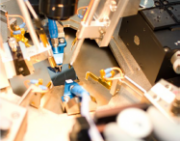
A chip with graphene-based devices fabricated at AMO/ELD. ©Martin Braun
Today, there is little doubt that devices based on graphene and other two-dimensional (2D) materials can exceed the state of the art for certain applications, thanks to their intrinsic properties. Two-dimensional materials are also seen as some of the most promising candidates for realizing ultimately scaled transistors at the end of the roadmap of silicon technology. However, devices based on 2D materials often show poor electrical stability, meaning that their behavior changes depending on their operation history.
“Component reliability is one aspect that is often neglected in research, but where we have been working for several years, because it is of central importance for applications.” explains Professor Max Lemme, scientific director of AMO GmbH and Head of the Chair of Electronic Devices at RWTH. The instability is not only caused by 2D materials themselves, but mostly by charges trapped into the oxide-insulator used to fabricate the transistors. “Ideally, one would like to use a different insulator with fewer charge traps,” says Lemme, “but there are no scalable solutions for this yet. In our work, we have shown instead that it is possible to use a standard insulator such as aluminum oxide and to significantly suppress the adverse effects of the charge traps in the oxide, by adjusting the charge carrier density in the 2D material.”
The work combines a thorough theoretical analysis of the novel approach – dubbed by the authors ‘stability-based design’ – and a proof of principle demonstration of the concept, performed by measuring different types of graphene-based FETs. The key idea of the approach is to try to engineer the combination 2D-material/insulator in such a way that the energy of the charge traps in the insulator is as different as possible from the one of the charge carriers in the 2D material. Lemme explains: “Graphene based FETs were the ideal test bed for our approach, as it is relatively easy to tune the energy of charge carriers in graphene. The approach, however, is applicable to all FETs based on 2D semiconductors”. These results represent a major step forward towards stable and reliable 2D materials transistors to be integrated in semiconductor technology.
Bibliographic information:
T. Knobloch, B. Uzlu, Y. Yu. I.llarionov, Z. Wang, M. Otto, L. Filipovic, M. Waltl, D. Neumaier, M. C. Lemme, T. Grasser, Improving stability in two-dimensional transistors with amorphous gate oxides by Fermi-level tuning, Nature Electronics (2022) – Open Access
DOI: 10.1038/s41928-022-00768-0